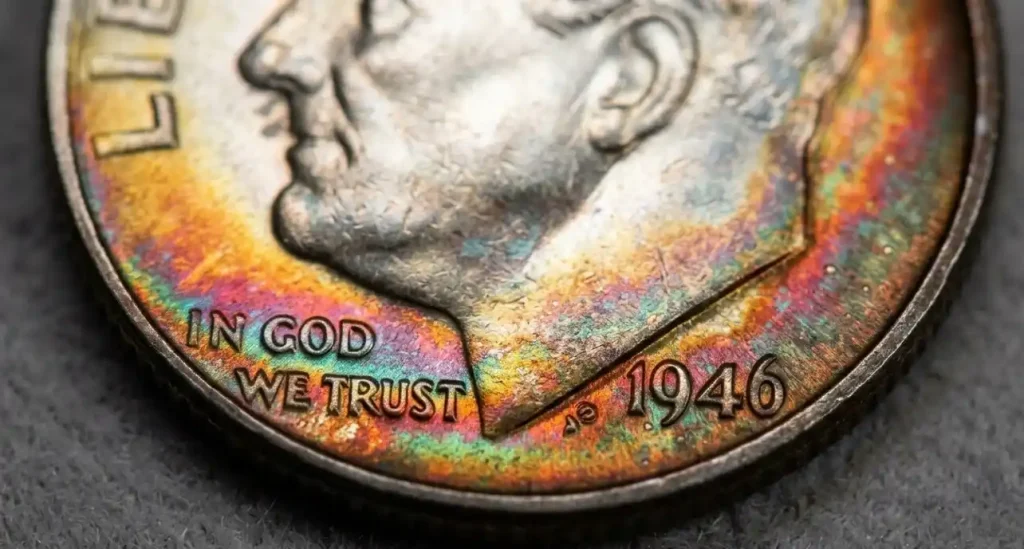


Issuing the 1946 coin represents a specific 1946 dime value due to the high silver content later removed from mass production.
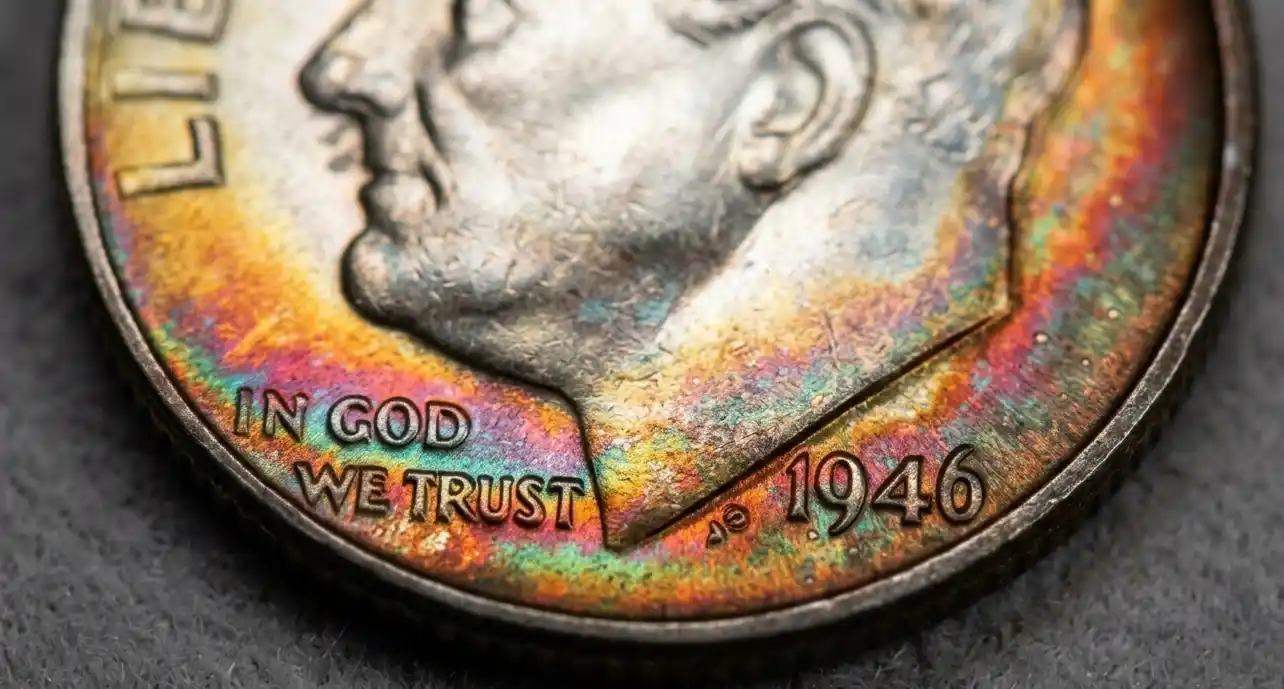
| Parameter | Value |
| Mass | 2.50 g |
| Diameter | 17.90 mm |
| Thickness | 1.35 mm |
| Composition | 90% silver, 10% copper |
| Pure silver weight | 2.25 g |
| Edge type | Reeded |
| Designer | John R. Sinnock |
Using 90% silver makes the coin dependent on precious metal prices.
Metal density allows retaining relief details even after long contact with other coins.
Production Statistics by Mint
Mintages of 1946 reflect the post-war economic need for small change.
Production took place at three primary facilities.
- Philadelphia → no mint mark → 255,250,000 pieces
- Denver → D mark → 61,043,500 pieces
- San Francisco → S mark → 51,450,000 pieces
Total output exceeded 367 million specimens.
Huge quantities of surviving coins limit the price growth of common samples.
Rarity appears exclusively in high-quality segments or specimens showing specific minting errors.
2026 Price Indicators: Philadelphia (No Mint Mark)
Coins lacking a letter designation under the date originated at the main Philadelphia facility.
| Grade | 2026 Price |
| VG8 | $2.65 |
| VF20 | $2.90 |
| EF40 | $3.25 |
| AU50 | $3.80 |
| MS63 | $7.50 |
| MS65 | $18.00 |
| MS67 | $95.00 |
Annual price growth of 3% occurs for MS65 condition.
Specimens graded MS68 show a sharper increase due to a lack of supply.
Record prices for Philadelphia coins in MS68 FB condition reached $3,800.
Features of Denver Mint Coins (D Mark)
Denver’s 1946 issue features a high-quality strike occurring frequently.
Mint mark D sits above the date on the left side.
Denver market indicators:
→ MS65 condition: price $22.00
→ MS66 condition: price $35.00
→ MS67 condition: price $110.00
Value dynamics over the last five years:
2021: $18.00 → 2026: $22.00 (increase of 22.2%)
Presence of a full torch strike on the reverse increases value 2.5 times.
Specifics of the San Francisco Issue (S Mark)
San Francisco’s mintage was the smallest among all facilities in 1946.
Small supply creates conditions for long-term investment interest.
| Condition | Price with S Mark |
| AU58 | $4.50 |
| MS64 | $12.00 |
| MS66 | $32.00 |
| MS67 | $145.00 |
| MS68 | $850.00 |
Auction records for 1946-S reach $9,400 for specimens exhibiting exceptional preservation.
Price drops of 5% affect coins showing visible dark oxidation spots.
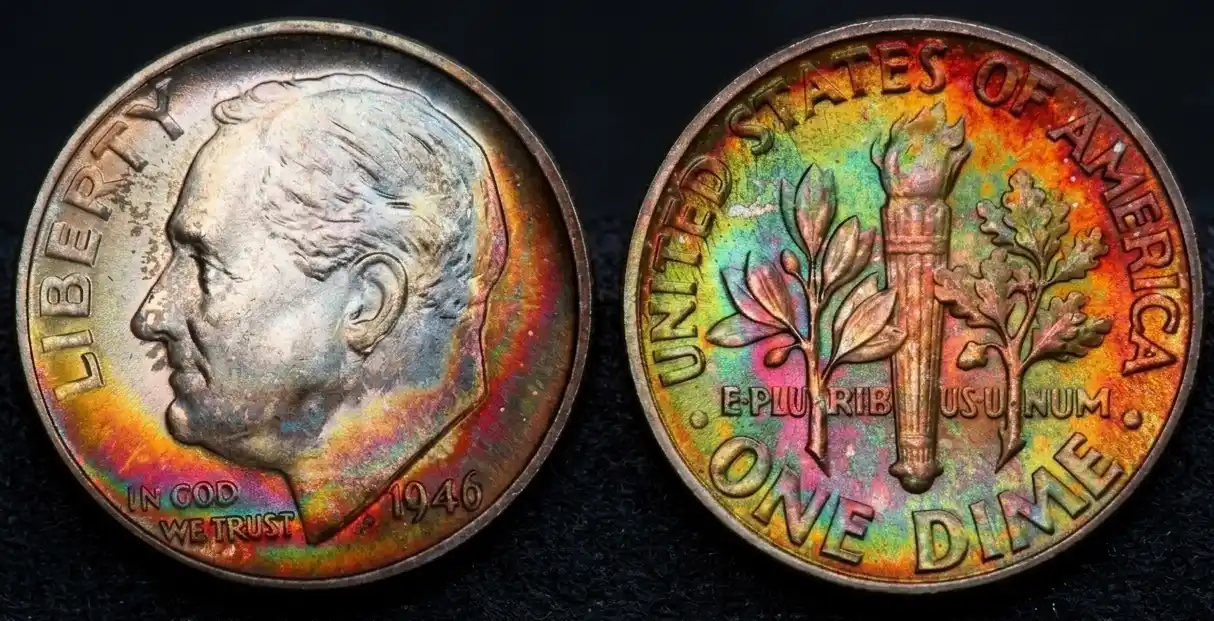
Silver reacting with the environment often forms toning.
Technical Term Full Bands: Impact on Evaluation
Professional evaluation of Roosevelt Dimes relies critically on the Full Bands parameter.
This refers to horizontal dividing lines on the torch located on the reverse.
- Clear separation of the upper and lower pairs of bands
- Absence of damage interrupting the lines
- Full depth of the relief strike
Coins carrying the FB designation sell much higher than standard samples.
Price gap statistics for MS66 condition:
Standard strike: $30.00 → FB strike: $85.00
Reason for the gap → difficulty obtaining a perfect impression of the central reverse during high-speed minting.
Minting Errors and Rare Varieties
Technological failures in 1946 led to the appearance of collectible anomalies.
Most significant variants:
- Doubling of obverse elements
Double lines appear clearly on the IN GOD WE TRUST inscription.
Price in MS63 condition stays around $120.00.
- Off-center strike
10% shift → price $75.00.
50% shift retaining the date → price $550.00.
- Using blanks of another denomination
Rarest cases involve a dime struck on a cent blank.
Price for such artifacts exceeds $2,000.00.
- Die clogging
Clogs lead to missing letters or numbers.
Price varies from $15.00 to $45.00.
Detecting such defects requires using a coin value checker app.
Factors Determining Annual Price Change
Investment appeal of the 1946 dime forms under several market forces.
Price change mechanics:
- Silver price on the exchange.
Rising metal prices → higher minimum price floor for the coin.
Impact is direct, representing about 85% of value for coins in poor condition.
- Population reports from certification services.
Increasing numbers of known coins in MS67 grade → 4-7% price drop annually.
Stability of rare grades → capital preservation.
- Inflation processes.
Currency depreciation → nominal price growth of antiques by 2-5% yearly.
- Preservation of mint luster.
Loss of luster due to improper storage → 40% value drop.
| Metal price per gram | Metal value in coin |
| $0.80 | $1.80 |
| $1.00 | $2.25 |
| $1.20 | $2.70 |
These calculations apply to coins lacking numismatic value.
Grading Procedure and Condition Classification
Condition evaluation follows strict criteria excluding subjective perception.
Description of key categories:
- Very Good (VG8).
Heavy wear across the entire surface.
Portrait remains visible but flat.
Letters of inscriptions merge with the rim.
- Fine (F12).
Basic hair lines of Roosevelt are visible.
Bands on the torch are almost completely worn away.
- About Uncirculated (AU58).
Minimal wear on the highest points of the relief.
Retention of mint luster on 90% of the area.
- Mint State (MS60-70).
Complete absence of wear from circulation.
Presence of small scratches received when falling into bags at the mint.
Using gloves during inspection prevents greasy deposits.
Cleaning a coin with abrasive substances removes its status as a collectible item.
Historical Context and Design
Replacing the Mercury coin resulted from the political need to honor the president’s memory.
John R. Sinnock, working on the portrait, used photographs and life sketches.
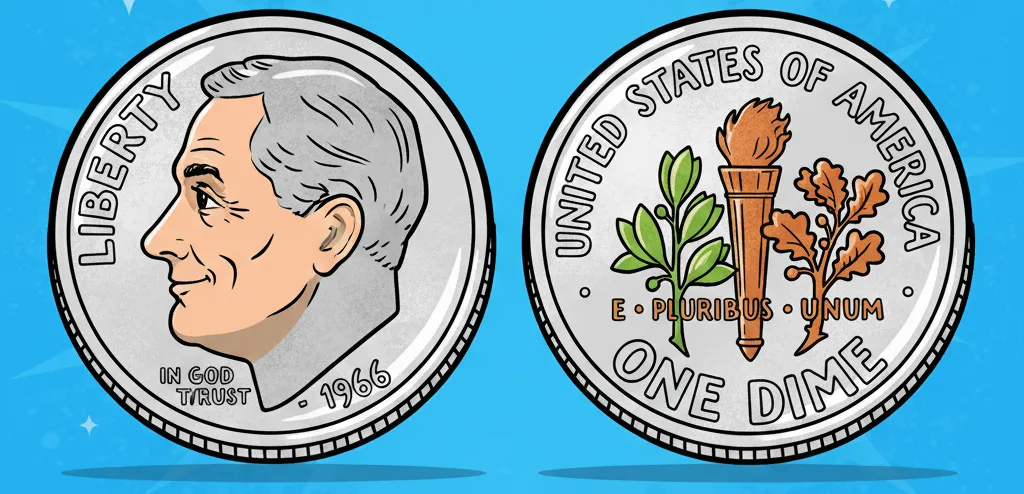
Obverse features Roosevelt’s profile turned to the left.
Right of the neck sit the initials JS, becoming the subject of false rumors in 1946.
Many citizens mistakenly took them for Joseph Stalin’s initials, demanding coin removal.
Authorities officially denied these claims, confirming Sinnock’s authorship.
Reverse shows a torch symbolizing liberty.
Olive and oak branches on the sides mean peace and victory respectively.
This design remains practically unchanged during 80 years of production.
Methods of Storage and Investment Protection
Preserving the original metal condition remains the owner’s main task.
90% silver tends to darken when contacting sulfur.
Safety recommendations:
→ Use of holders containing no PVC
→ Storage in a dry place with humidity below 35%
→ Exclusion of skin contact
→ Application of special capsules made of inert plastic
→ Scan coins for value regularly
Professional certification in PCGS or NGC services provides coin protection in a sealed slab.
Slabbed coins guarantee authenticity and a fixed grade during resale.
Liquidity Analysis at Auctions
The 1946 coin possesses high liquidity due to the series’ mass appeal.
Selling low-quality coins occurs by silver weight.
High-grade specimens require participation in specialized bidding.
2025-2026 sales statistics:
- eBay: over 15,000 lots of 1946 realized
- Heritage Auctions: 120 lots in grades above MS67
- Stacks Bowers: recorded interest growth in first-year sets
Liquidity period for a coin with a fair price ranges from 3 to 14 days.
Auction platform commissions vary between 10-20% of the transaction amount.